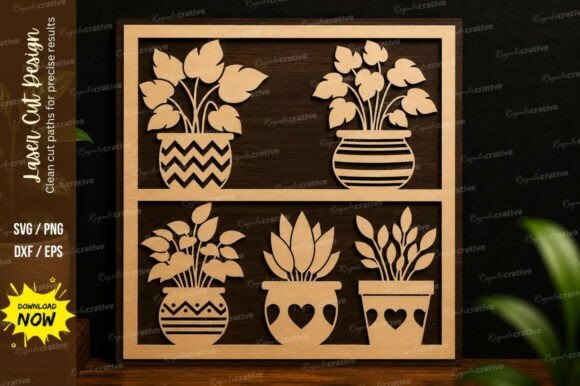
Evaluating the Potted Plants Shelf SVG Laser Cut Wall Design
The integration of greenery into interior spaces has become a staple of modern home decor, driving demand for creative and functional display solutions. Among the various methods to create custom shelving, digital fabrication stands out for its precision and repeatability. The Potted Plants Shelf SVG Laser Cut Wall represents a specific category of digital design files intended for use with laser cutting machinery. This article evaluates the utility, technical requirements, and practical applications of this design set to help makers and small business owners determine if it aligns with their project goals.
Understanding the Digital Asset
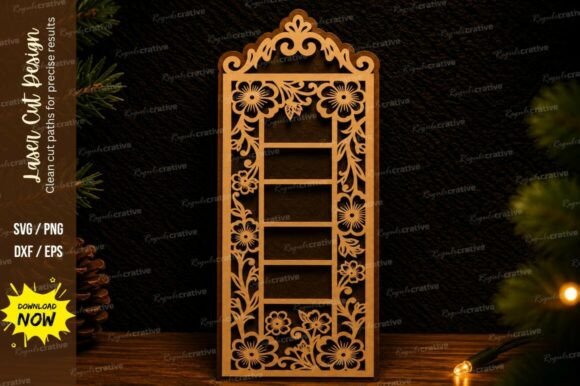
At its core, the Potted Plants Shelf SVG Laser Cut Wall is not a physical product but a collection of vector and raster files. These files contain the geometric paths and instructions necessary for a laser cutter or CNC machine to cut materials into specific shapes that assemble into a wall-mounted shelf system. The design typically features organic or geometric motifs resembling potted plants, which serve both as structural supports and decorative elements.
The value of this asset lies in its versatility across different software and hardware ecosystems. By including formats such as SVG, EPS, PNG, and DXF, the design set ensures compatibility with a broad spectrum of tools. SVG and EPS files are vector-based, meaning they define shapes using mathematical paths rather than pixels. This allows the design to be resized infinitely without losing edge quality, a critical factor when adapting a shelf to fit specific wall dimensions or material sheet sizes. DXF files are particularly important for users operating industrial-grade CAD software or older laser controllers that rely on this standard. Meanwhile, the inclusion of PNG files offers a raster reference, useful for visualizing the final outcome or for use in engraving processes where depth variation is required.
Reasons for Interest and Potential Applications
Individuals and businesses often seek out these design files for several strategic reasons. Primarily, they offer a significant reduction in design time. Creating a structurally sound shelf that balances aesthetic appeal with load-bearing capacity requires knowledge of joinery, material thickness, and weight distribution. A pre-prepared file set bypasses the initial engineering phase, allowing the user to focus immediately on production.
For small business owners selling handmade goods on platforms like Etsy or at local craft fairs, this design provides a scalable product opportunity. Once the file is purchased and downloaded, the marginal cost of producing additional units is limited to raw materials and machine time. Furthermore, the "Potted Plants" theme taps into the enduring popularity of biophilic design, making the end product attractive to consumers looking to bring nature indoors without the maintenance of live hanging gardens.
Hobbyists also find value in these files as a learning tool. Working with a proven design allows beginners to understand how tabs, slots, and interlocking mechanisms function in laser-cut assembly before attempting to create original designs from scratch.
Benefits and Technical Considerations
The primary benefit of utilizing a premium quality laser cutting design file set is the assurance of clean vector paths. Poorly constructed files often contain open nodes, overlapping lines, or non-vector elements that can cause a laser cutter to pause, error out, or produce jagged edges. A high-quality set minimizes these risks, leading to smoother operation and less post-processing sanding or finishing.
However, prospective users must consider several tradeoffs and technical variables. While the files are "ready for laser cutting," they are rarely universal. The most critical consideration is material thickness. Laser cut designs rely on precise kerf (the width of the cut made by the laser) and material density. A file optimized for 3mm plywood may not fit together correctly if cut from 4mm acrylic or 5mm MDF without modification. Users must possess the skills to adjust tab widths and slot depths within their design software to match their specific material inventory.
Additionally, while the design is compatible with most laser CNC machines, the capabilities of the machine itself dictate the final result. A diode laser may struggle to cut through thicker hardwoods required for sturdy shelves, whereas a CO2 laser handles these materials with ease. Users must evaluate their equipment's power and bed size against the dimensions of the shelf design.
Ideal Use Cases
This design set is a strong fit for scenarios where customization and speed are prioritized over unique, one-of-a-kind artistry. It is ideal for:
- Interior Decorators: Who need consistent, thematic shelving units for multiple client projects.
- Educational Workshops: Where students can assemble pre-cut kits to learn about structural engineering and botany.
- Event Stylists: Who require temporary, lightweight displays for weddings or exhibitions that can be easily transported and assembled.
- Prototypers: Looking to quickly visualize a spatial arrangement of plants before committing to a permanent installation.
In these situations, the ability to instantly download and begin production offers a clear logistical advantage. The variety of included formats ensures that whether the user operates a Glowforge, an xTool, or an industrial Epilog, the file will integrate smoothly into their workflow.
When to Consider Alternatives
Despite the conveniences, there are situations where alternatives may be worth considering. If a project demands heavy load-bearing capacity for large ceramic pots or heavy planters, a standard laser-cut shelf design might be insufficient. Laser-cut joints, while elegant, can be points of weakness if the grain direction of the wood is not accounted for or if the material is too thin. In such cases, traditional carpentry or metal welding might provide the necessary structural integrity.
Furthermore, if the goal is to create a truly unique artistic statement, relying on a popular, widely available SVG file may result in a product that lacks distinctiveness. Many designers sell similar "potted plant" themes; therefore, the market may become saturated with identical-looking shelves. For artists seeking brand differentiation, hiring a custom designer or learning to create original vector art from scratch would be a more strategic long-term investment.
Finally, users without access to a laser cutter should weigh the cost of outsourcing. Sending files to a local fabrication lab adds per-minute machine costs and setup fees. If the volume of production is low, purchasing a pre-assembled shelf or using simpler DIY methods like floating brackets might be more cost-effective than investing in digital files and external cutting services.
Making the Decision
Deciding whether to utilize the Potted Plants Shelf SVG Laser Cut Wall design ultimately depends on the intersection of your technical capabilities and project objectives. If you possess a laser cutter, understand how to adjust vectors for material thickness, and need a reliable, aesthetically pleasing solution for displaying small to medium-sized plants, this file set offers a high-value starting point. The inclusion of multiple formats reduces technical friction, allowing you to focus on material selection and finishing.
Conversely, if your project involves heavy loads, requires absolute uniqueness, or if you lack the means to modify vector paths for specific materials, exploring alternative construction methods or commissioning custom work may yield better results. By objectively assessing these factors, makers can ensure that their choice of digital assets leads to successful, durable, and visually appealing outcomes.