Integrating the Floral Bee Laser Cut SVG File into Professional Crafting Workflows
In the realm of digital fabrication and modern crafting, the transition from a conceptual idea to a tangible product relies heavily on the quality and compatibility of source files. For professionals, small business owners, and serious hobbyists, the Floral Bee Laser Cut SVG File represents more than just a decorative image; it is a foundational asset designed to streamline production processes. Whether you are operating a Glowforge in a home studio or managing a fleet of OMTech machines for a small manufacturing business, the integrity of your vector data dictates the efficiency of your output. This article explores how this specific design fits into broader creative and commercial workflows, ensuring that your projects move smoothly from planning to execution.
The Role of Vector Integrity in Production Planning
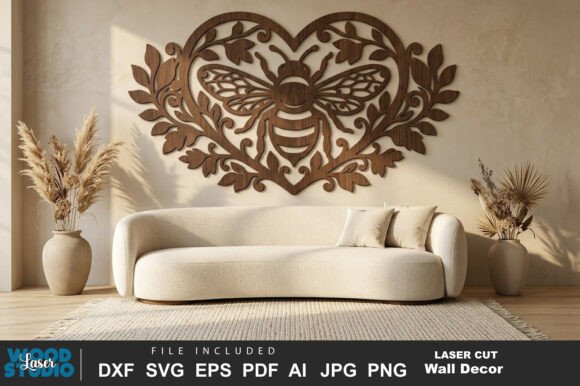
Before a laser cutter ever powers on, the preparation phase determines the success of the project. A common bottleneck in laser cutting workflows is dealing with poorly constructed vector files that contain floating elements, open paths, or disconnected nodes. The Floral Bee Laser Cut SVG File addresses these issues at the source by providing a fully connected structure. This means every petal, leaf, and segment of the bee is mathematically linked to the main body of the design.
For a workflow focused on efficiency, this connectivity is crucial. When importing files into software like LightBurn, Adobe Illustrator, or Inkscape, a connected layout eliminates the need for manual path welding or node repair. This saves significant time during the pre-production stage, allowing creators to focus on material selection and machine calibration rather than troubleshooting file errors. The clean vector paths ensure that the laser head follows a continuous, logical route, reducing unnecessary travel time and minimizing the risk of scorching caused by the laser lingering on disconnected points.
Material Compatibility and Process Adaptation
One of the strengths of incorporating the Floral Bee Laser Cut SVG File into your toolkit is its versatility across various substrates. In a professional setting, you rarely work with just one material. Your inventory might include plywood for structural decor, acrylic for signage, leather for accessories, or MDF for cost-effective prototypes. Because this design is built with precise vector geometry, it adapts seamlessly to these different mediums without requiring fundamental changes to the artwork.
When working with wood or plywood, the fully connected nature of the file ensures that intricate floral details do not fall out prematurely during the cutting process. This is particularly important for wall art and decor where structural integrity is paramount. For acrylic users, the smooth cutting structure prevents melting or jagged edges, resulting in a polished finish that requires minimal post-processing. By standardizing on a high-quality file format, businesses can maintain consistency in product quality regardless of the material being used, which is essential for brand reputation and customer satisfaction.
Software Integration and File Format Flexibility
A robust workflow demands flexibility in software ecosystems. Different operators prefer different tools; some rely on the user-friendly interface of LightBurn, while others require the advanced editing capabilities of Adobe Illustrator or the open-source power of Inkscape. The Floral Bee Laser Cut SVG File package supports this diversity by including multiple file formats: SVG, EPS, AI, DXF, PDF, PNG, and JPG.
- SVG and DXF: These are the primary formats for direct import into laser control software like LightBurn, xTool Creative Space, or CNC controllers. They preserve the vector data necessary for precise cutting paths.
- AI and EPS: Ideal for designers who need to modify the scale, adjust line weights, or integrate the bee motif into larger composite designs before sending them to the cutter.
- PDF: Useful for quick proofing or sending to clients for approval before committing to material costs.
- PNG and JPG: High-resolution raster versions serve marketing needs, allowing for immediate use in social media previews, website listings, or printed catalogs without needing to render the vector file.
This multi-format approach ensures that the asset fits naturally into various stages of the business cycle, from initial design iteration to final marketing and sales.
Scaling Operations and Customization
As a business grows or a project evolves, the ability to resize and customize assets without losing quality is vital. Vector-based designs like the Floral Bee Laser Cut SVG File offer infinite scalability. Whether you are creating a small keychain charm or a large-scale wall installation spanning several feet, the vector paths remain crisp and accurate. This scalability supports dynamic pricing models and product diversification. A creator can easily adapt the same core design to fit different price points and market segments simply by adjusting the dimensions in their vector editor.
Furthermore, the clean structure allows for easy modification. If a client requests a specific variation—such as removing certain floral elements to simplify the cut for a thinner material—the connected nodes make editing straightforward. There are no hidden layers or grouped objects that complicate the modification process. This level of control empowers entrepreneurs to offer bespoke services, tailoring products to specific customer requests while maintaining rapid turnaround times.
Quality Control and Long-Term Usability
In any production environment, quality control is non-negotiable. Using a file with "no floating or separated elements" significantly reduces the margin for error. When a design has loose pieces, they can shift during the cutting process, leading to misaligned cuts or ruined materials. The engineered stability of the Floral Bee Laser Cut SVG File mitigates this risk, ensuring that the final product matches the digital preview exactly.
From a long-term usability perspective, investing in high-quality, professionally constructed files reduces waste. Fewer failed cuts mean lower material costs and less time spent on re-runs. For educators teaching laser cutting techniques, this file serves as an excellent example of proper vector construction, helping students understand the relationship between digital design and physical output. For publishers and content creators, it provides a reliable visual asset that enhances the aesthetic value of their projects without introducing technical headaches.
Practical Implementation Tips
To maximize the benefits of this asset within your workflow, consider the following practical steps:
- Pre-Flight Check: Even with clean files, always perform a quick visual inspection in your chosen software (LightBurn, Illustrator, etc.) to confirm line colors correspond to your intended cut settings (e.g., red for cut, blue for engrave).
- Material Testing: Before running a full batch, execute a test cut on a scrap piece of your intended material. This verifies that the power and speed settings align with the complexity of the floral details.
- Organization: Store the received files (SVG, AI, DXF, etc.) in a structured digital library. Tagging them by project type or material compatibility can speed up future retrieval and reuse.
- Post-Processing Planning: While the file ensures clean cuts, plan your sanding, painting, or assembly station in advance. Knowing that the pieces will fit together perfectly allows you to optimize your finishing workflow.
By integrating the Floral Bee Laser Cut SVG File into your operational routine, you bridge the gap between creative vision and mechanical precision. It is a tool that supports not just the act of cutting, but the entire ecosystem of planning, designing, producing, and selling. Whether you are a freelancer looking to expand your product line or a manufacturer aiming for higher throughput, the reliability and versatility of this design make it a valuable component of a modern, efficient workflow.